
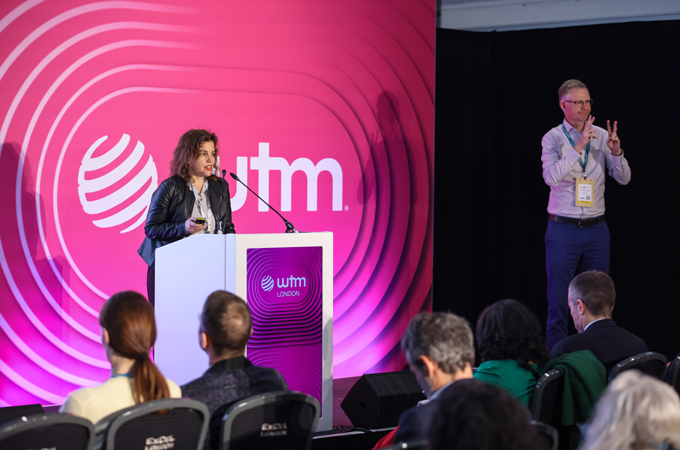
WTM London 2026 opened with discussions on the changing priorities of global travellers, the growing importance of experiential and accessible tourism, and the expanding role of artificial intelligence (AI) across the travel industry.
The first day of the
three-day event featured the launch of the WTM Global Travel Report, produced
in association with Tourism Economics, alongside a newly structured conference
programme bringing together industry leaders, tourism authorities and travel
businesses.
The report highlighted
changing consumer spending patterns, with Dave Goodger, Managing Director of
Tourism Economics, noting that although declining consumer spending power
remained a challenge, “travellers are reallocating resources and looking to
save where they can.”
Sean Morgan, Head of
Travel Research at Tourism Economics, said 60% of travellers surveyed wanted
“luxury” holidays, with experiences playing a central role in their travel
decisions.
Luxury and
experiential tourism emerged as key themes throughout the opening day's
discussions. Chase Gray of Skift Advisory said luxury would increasingly be
defined by “access not excess”, identifying three emerging traveller groups
that businesses should consider when developing future strategies.
These include prestige
travellers seeking recognition and exclusivity, those prioritising enrichment
through personal growth and development, and travellers looking for stronger
connections with family and friends.
Experiential
tourism drives travel demand
The growing demand for
experience-led travel was also highlighted in discussions on the Experience
Economy, where Angela Val of Visit Philadelphia outlined the economic
opportunities associated with creating tourism activities around major events.
Using Taylor Swift
concerts as an example, she explained how Philadelphia had developed activities
encouraging visitors to extend their stays and explore the destination beyond
the main event.
“That has really
changed the way we look at concerts in Philadelphia,” she said. “It has become
normal [for people to] go to a concert and want to experience something outside
of it… to embrace it for the three days [they’re] there.”
Philadelphia also
capitalised on the FIFA World Cup by organising free fringe events, with its
Fanfest becoming the most attended of the tournament. Val noted that “70% of
people who go to the World Cup don’t have a ticket”.
A panel discussion on
passion tourism, covering music, sports and cultural events, further explored
the commercial potential of event-led travel.
Luiza Fortuna of
Superstruct Entertainment shared findings from Awakenings, a Dutch techno
festival, where international visitors account for a significant proportion of
attendance.
“The audience is
pretty much a 50-50 split of Dutch and international visitors. But of these
international guys, 80% of them say that they wouldn't go to the Netherlands if
it was not for the festival”.
The Global Travel
Report also found that 58% of international travellers had travelled abroad
specifically to attend an event during the previous two years.
Cruise operators are
similarly investing in experience-led offerings. Chinese luxury river cruise
operator Century Cruises outlined plans to expand across Europe and North
Africa, following the introduction of a Rhine-Danube vessel in 2026. Another
ship is scheduled for 2027, while Nile cruises are planned for 2028.
Its offering will
include enhanced culinary experiences, cultural celebrations and exclusive
shore excursions, including private opera performances in Vienna.
David Fredericks,
President and CEO for the Americas at Century Cruises, said: “If we were a
hotel brand, we would fashion ourselves after Mandarin Oriental or Shangri La.”
Accessibility gains
industry attention
Accessible tourism was
another major focus, with the Spanish Tourist Office launching a hotel advice
guide and social media campaign under its Spain for All accessibility strategy.
The initiative,
developed over three years in collaboration with an advisory council
representing the UK and Spanish travel industries, aims to help hotels
communicate their accessibility provisions more effectively.
“Today we’re
publishing a report which gives hotels in Spain and around the world the tools
they need to communicate how accessible they are,” said José Manuel de Juan
González, Director of the Spanish Tourist Office in the UK.
Miguel Carrasco,
Director of Tourism and COO for several accessibility organisations, added:
“Accessible tourism is not a different kind of tourism, it is what better
tourism looks like.”
AI reshapes travel
operations and customer experience
Artificial
intelligence also featured prominently, with industry discussions focusing on
its potential to improve customer service, streamline operations and influence
how travellers discover and book holidays.
Garry Wilson, CEO of
easyJet Holidays, discussed the company's approach to AI, explaining that
automation could handle routine customer enquiries, allowing employees to focus
on more complex requests.
He also highlighted
the importance of ensuring the company's products remain visible through
AI-powered search platforms.
“The meaningful thing
for us is to think about how we can display the content in a way that is
attributed back to easyJet holidays,” he said.
On WTM's Future Stage,
Ani Attamian stressed that “correct, connected and clear data” was essential
for businesses seeking to integrate AI into their operations and customer
services.
She cited a 3,500%
year-on-year increase in generative AI traffic to US travel websites in July
2025, highlighting the technology's growing influence on travel research and
discovery.
Attamian also
referenced IKEA's decision to retrain 8,500 customer service employees into
remote interior design and advisory roles following the introduction of its AI
chatbot Billie. The initiative reportedly generated $1.37 billion in revenue by
redirecting employee capacity towards higher-value services.
Natalia Talkowska of
Natalka highlighted the continuing importance of human emotions and personal
connections in an increasingly technology-driven environment.
“The brain cares about
stories that evoke emotion” she said, urging travel businesses to “Stand out by
creating desire,” through experiences that encourage meaningful interaction.
“Gathering audiences
is the new luxury”, she stated, suggesting the travel industry “needs to build
a world that connects people.”
Strong industry
participation
Concluding the opening
day, WTM London Event Director Chris Carter-Chapman highlighted strong
attendance and business engagement, describing a “fantastic buzz” across the
exhibition.
Acknowledging the
challenges facing the travel industry, he praised its “strong resilience,”
which aligned with this year's event theme.
He also recognised
Egypt as the event's Premier Partner and highlighted the participation of more
than 12,000 approved buyers and over 4,000 registered media representatives.
The opening day's attendance, he said, “this really communicates the importance of the show within the UK economy.” -TradeArabia News Service